

In the past, when the colleges or schools want to communicate with their students or other colleges, they have to be physically present at the site of discussion. Also when they intended to cooperate with other colleges, universities or intend to make their children learn skills that are not given there, they usually sent the person to another place to learn. Although it worked well to a great extent, it has gradually become very difficult due to the expansion of territories and the number of colleges. It is also subjected to the limit of time and territories deeply. The process takes a lot of time and money for the institutions/ colleges and mainly to back and forth between two destinations.
However, in the present day, things are changing and education happens through video conferencing and video communication learning. With the introduction of video communication, the colleges and universities are not limited by the borders of the region of their location and they can freely conduct any academic conference, webinar or teacher training with other institutions and colleges. The video communication is a powerful solution to this problem. The video communication and video conferencing software and tools like EZTalks, Zoom Meetings, enables to hold up to 100-participants online class for free and the participants, within less than a minute can see and hear the other attendee dispersed in different places, chat with them, and share useful information. It also provides the facility of viewing of a whiteboard, screen and more with each other as if all of you were in the same room.

Classroom studies, being a traditional way of education is still popular in many parts of the world, but this way of study is prone to slow learning and limited knowledge. Classroom studies are the old boring way, that most of the students take for granted. This also does not ensure proper monitoring and record-keeping of everyday activities and hence, it becomes very hard to focus on the learning of each and every student present in the classroom. It is very important that every student coming to a college learns and not only just be physically present for attendance. The students, who live in a remote rural area may still not have the opportunities to learn and grow, especially when the colleges are located far away from their homes. So, in these conditions, it is a very good idea to adopt video communication for virtual classrooms. This will help in the education of students and the students don’t need to go for a long distance to attend school. They will also experience a virtual trip without going to college/ university.
This will also help to establish direct communication, between the college authority and educators, who can also communicate with each other and their students in real-time. The positive results of this change can be experienced from day one.
The video communication education allows for face-to-face meetings with professors and lecturers across the world in different times zones. This will also support the students to access online courses and learn from the faculties and experts from different universities around the globe. It will also help to create a student intercommunication network, through which they can connect and experts and also to collaborate and work on projects together.
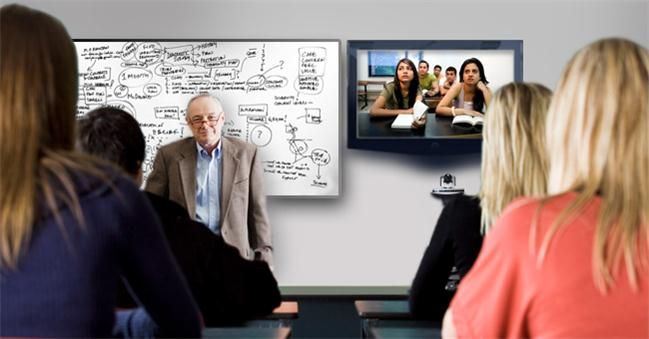
Video conferencing and video communication education help the students to take advantage of the collaborative and hybrid classroom, attend regular, in-class sessions for a particular course and to take the distance learning & education to the next level. It will allow innovative educators to plan interactive teaching based on their students’ needs, no matter what the location of the student, university, college, and experts was.
This helps the students to work on a project and do research on the same projects in a collaborative environment, doing face-to-face chats and sharing ideas and feedback. Video communication has high benefits with relatively little investment and it also does not require on-site deployment, it on other hand reduces the infrastructure expenses for institutions.
The video communication software supports recording and playback. So, even when the teachers are teaching, the student can record the teaching lessons and can review it anytime later. This will help in revision too. The university/ college can deploy video conferencing and video communication software and tools to manage the online learning of students. It can be used easily across various mobile devices like iOS and Android, as well as traditional desktop and laptop platforms supporting Mac and Windows operating systems.
Some features of video communication software includes :
Easy-to-use platform, to learn anytime, anywhere.
Unnecessary hassles or travel.
Collaborative learning and teaching technique, where people could do face-to-face meetings, ask questions and clear doubts.
Flexible meeting schedule and high mobile accessibility.
The biggest advantage is the country borders does not limit the study and high aspirations, students can learn from any university, take a degree from any abroad college and institution of their choice. The advantages are numerous, investment very low and when everything is going advanced, why not the way of study. Think!!
Hope this information is useful to you.

This article is sole right of fast-tech computer Education and any copy and plagiarism is prohibited.
For more such articles, stay connected with us!! Thank you.




 Fast-tech Computer Education
Leave a comment